
Chapter Text
In the silence of your eyes
I hear the prayers of forgotten time
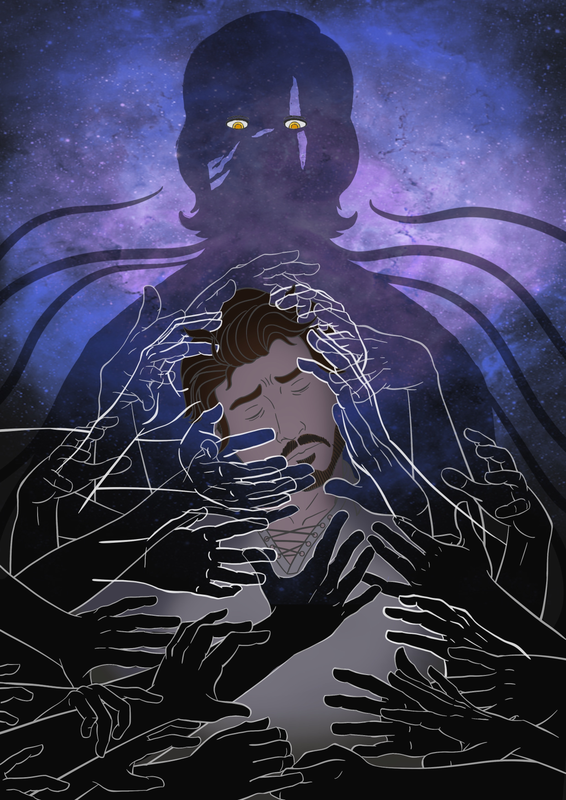
Gorgeous art (and teaser for what's to come hehe) by Izzy
The temple breathed with the mountain.
High above the treeline, where the air thinned and the wind carried nothing but silence, Clea's sanctuary rose from the living rock as though it had always been there — as though the mountain had grown upward just to hold it. White marble columns climbed in impossible rows, their surfaces carved so smooth they caught the dawn like still water, each one wide enough that three men could not link arms around its base. Between them, the halls stretched vast and open to the sky, and the morning light fell in long pale sheets through archways that framed nothing but cloud.
It was a place built to make the body remember its smallness.
Gustave moved through it the way he did every morning: quietly, deliberately, alone. His sandals whispered against the marble floor — a stone so cold it never fully warmed, not even in high summer, not even where the sun pooled in bright geometric squares between the columns. He carried a brass censer in his right hand, trailing pale smoke that the mountain air pulled apart almost before it could rise. His left sleeve hung empty, pinned neatly at the shoulder. Beneath the fabric, the stump ached with the dull, familiar insistence of a wound that had healed years ago but never stopped hurting.
He swung the censer in a slow arc as he walked the eastern colonnade. The smoke curled around the columns, caught in their fluting, dispersed. The ritual required only one hand. He had learned, in the years since, to perform every duty one-armed — lighting the braziers, folding the altar cloths, lifting the offering bowls from their hooks along the sanctuary wall. His body had relearned itself around the absence, muscle and habit reshaping until the motions looked almost seamless.
Almost. There was always the pause. The half-second where his left shoulder dipped toward something that was not there, where his body reached before his mind could catch it. A phantom reflex. The arm remembered itself even when the rest of him tried not to.
The censer smoke drifted upward into the vaulted emptiness above him, thinning, vanishing. Somewhere far overhead, the columns met in arches so high they blurred — the ceiling (if there even was a ceiling; he had never been entirely sure) lost in a pale haze of altitude and light. The temple did that. Drew the eye upward and upward until the human figure at its base became irrelevant, a small warm thing crowding the halls designed for something larger, something colder, something that did not breathe.
The goddess Clea's presence lived in that scale. Not in any statue or icon — though there were statues, pale and severe and lovely, their gold-leafed eyes watching from alcoves along the nave — but in the architecture itself. The immaculate geometry. The way every angle resolved into symmetry, every surface gleamed without flaw, every shadow fell in clean straight lines as though even darkness here obeyed a higher order. Her temple was her theology made stone: that perfection existed, and it was beautiful, and it did not care whether you could reach it.
Gustave set the censer on its hook beside the eastern altar and knelt.
The marble pressed into his knees, hard and smooth and familiar. He folded his hand — hand, singular, always singular — and lowered his head. The morning prayer came without thought. Words he had spoken so many times they had worn grooves in his mind, the way water wore grooves in stone: Clea, bright and unbroken. Clea, whose hand shapes the world toward its truest form. I am your instrument. Make me worthy of the shaping.
The words rang through him and left nothing behind.
He stayed kneeling a moment longer than the prayer required. He tried telling himself it was devotion, though he knew deep down it was something closer to inertia. It was the stillness of a man who has finished speaking and is listening for an answer he no longer expects to hear. The marble breathed its cold into his knees. Above him, the columns rose and rose and rose into the pale nothing of the sky.
Nothing answered.
He stood, brushed the cold from his robe with his one hand, and turned toward the sound of footsteps.
Emma came down the eastern colonnade with the sun behind her, and for a moment she was all silhouette and motion — tall, long-limbed, her dark brown hair braided close to her skull in the style the temple required. Then she stepped out of the light and into detail, and Gustave felt the small bright ache of looking at her, the one he couldn't quite suppress, even after all this time.
She was his mirror. His twin, born minutes after him, carrying the same jaw, the same deep-set eyes, the same hands — hand — the same quiet way of holding her shoulders. They had gone into Clea's trial together, knelt side by side on this same marble floor, offered themselves to the goddess's shaping. And they had both been found worthy. And they had both paid.
Emma's left eye was gold-veined marble, smooth and luminous, set perfectly in the socket where her own eye had been. It caught the morning light now and held it — warm, almost alive, beautiful in a way that made strangers stare. Clea's gift. Clea's restoration. The goddess had taken, and then she had given back, and Emma moved through the world whole and holy and complete.
Gustave's left sleeve hung empty.
He did not think about this. He had trained himself, carefully and over years, not to think about this.
"You're up early," Emma said, falling into step beside him. Her voice was warm — the kind of warmth the marble never held. She bumped her shoulder lightly against his right arm, the easy closeness of someone who had shared a womb, a childhood, a god. "Couldn't sleep?"
"I slept fine." The lie came easily. He had lain awake until the small hours, his phantom arm throbbing in the dark, the stump sending bright threads of pain up into his shoulder and along a limb that did not exist. "Just wanted to get the censing done before the hall fills."
Emma studied him with her mismatched eyes — one hazel, one gold and marble, both sharp. She had a way of looking at him that made him feel transparent, as though she could see every evasion, every half-truth, the whole careful pretense of I'm fine that he had built around himself like a second temple.
She did not press. She never pressed. That was her kindness to him, and some mornings it felt like mercy, and other mornings it felt like one more silence in a place already drowning in them.
"I'll take the western altar," she said. "Maelle wants to help with the flowers later — she's been up since before dawn arranging stems. I think she's trying to impress you."
The corner of his mouth lifted. "She doesn't need to impress me."
"Try telling her that." Emma touched his arm — his right arm, always his right arm, because she knew exactly where the pain lived — and moved past him toward the western colonnade.
He watched her go. The gold eye caught the light once more as she turned, a brief warm flash against the cold white marble, and then she was gone around the curve of the column, and he was alone again in the vast pale silence of the hall.
He stood there a moment longer. His left shoulder ached. The phantom fingers curled and uncurled in empty air, grasping at nothing, remembering a weight they would never hold again.
The temple breathed around him: stone and light and the faint lingering sweetness of censer smoke. Beautiful and cold and indifferent, the way divinity always was. The way it had to be.
Gustave turned away from the altar and walked on, one-armed, into the morning.
The flowers were a disaster, though not for lack of trying.
Maelle had arranged them with fierce concentration, her brow furrowed, her small hands working stems into precise formations along the altar's edge. White lilies and pale anemones, their petals cool and waxy, laid out in patterns that aspired to Clea's geometric perfection. But the vases were heavy, broad-bottomed things carved from the same white marble as everything else in this place, and filling them from the stone basin required two hands — one to hold the vase steady, one to work the ladle.
Gustave watched her struggle with it from the doorway of the vestry. She had the vase braced between her hip and the basin's edge, pouring with both hands on the ladle, water sloshing over the rim and darkening the stone floor in uneven splashes. She hadn't asked for help. She never asked for help.
She was sixteen and stubborn, and she had decided very early that needing things from people was a weakness she could not afford. The temple had raised her — an orphan left at the gates in a winter storm, one of Clea's foundlings, taken in because the goddess's doctrine demanded charity even if the goddess herself seemed indifferent to it. Maelle had grown up among the priests and acolytes, bright and sharp-tongued and fierce, and somewhere along the way she had attached herself to Gustave with the tenacity of a vine finding stone.
He understood why. He was the one who didn't flinch when she was difficult, who let her temper burn itself out without taking it personally, who never made her feel small for the things she didn't know. He was also, he suspected, the only person in the temple who understood what it meant to carry an absence where something vital should be — his arm, her parents, the excruciating ache of a space that never fills.
"You're going to crack the basin," he said from the doorway in the way of greeting.
Maelle startled, caught, and the vase slipped. Gustave was already moving — three quick steps, his right hand catching the vase before it hit the floor, water arcing across his forearm and soaking the sleeve of his robe. The vase was heavy. It wanted a second hand to steady it. His left shoulder jerked, the phantom reflex again, reaching for a grip that wasn't there.
He set the vase on the edge of the basin, carefully, one-handed.
"I had it," Maelle said. Her jaw was set and Gustave knew it meant she was embarrassed and furious about being embarrassed. Reddish-brown hair escaping its braid, sleeves shoved past her elbows, a smear of pollen across one cheek like warpaint.
"You had about half of it, if I were inclined to be generous."
"I had most of it. The vase was just — the marble's slippery when it's—"
"Wet. Yes. Stone tends to do that."
She glared at him. He held the look until her mouth twitched, just barely, fighting itself. Then she looked away, swiping at the pollen on her cheek with the back of her hand and succeeding only in spreading it further.
"The stems are good," he said, and meant it. She'd laid them out with genuine care — the lilies in concentric arcs, the anemones filling the spaces between, a structure that echoed the temple's own geometry but softer, more alive. "You've got an eye for it."
The flush that climbed her neck was pleased, though she'd bite her own tongue before admitting it. "I studied the way Sister Odile arranges the high altar flowers. The radial pattern, how she offsets the—" She stopped herself, shrugged. "It's just flowers."
"It isn't just anything, if you do it with attention. That's the whole point of this place."
He helped her fill the remaining vases. She held each one while he worked the ladle — a simple arrangement, his one hand to her two, the kind of seamless compensation that had become second nature to both of them. Maelle never commented on it. Never made a show of helping or of not helping. She simply appeared in the empty space beside him and did what needed doing, the way she always did, as though his body were whole and she were merely standing close.
That was her gift to him, and most days he could accept it.
She carried the filled vases to the altar, arranging them with quick sure hands while he dried the splashed water from the floor with a cloth. The vestry smelled of lily pollen and cold stone and the faint mineral sweetness of mountain water. Morning light glided across the floor in slow bright parallelograms, marking time.
"You look tired," Maelle said, not looking at him.
"I'm fine."
"You say that a lot."
"Because it's usually true."
Now she looked at him — a sharp sidelong glance, too perceptive for sixteen. She had a way of seeing him that was different from Emma's careful, knowing gaze. Emma saw what was wrong and respected his need to hide it. Maelle saw what was wrong and wanted to drag it into the light and fix it with her bare hands, whether he liked it or not.
"You're not sleeping," she said. Not a question.
"Maelle—"
"Your eyes are doing the thing. The twitchy thing. And you're slower in the morning when you haven't slept — you pause more before you reach for things."
He stared at her. She stared back, defiant, arms crossed, a lily petal caught in her hair.
"I'll sleep tonight," he said, because it was easier than the truth, which was that the nights had become long and strange, the dark hours stretching around him like a held breath, his phantom arm aching with a restlessness he couldn't quite understand. "I promise."
She held his gaze a moment longer, measuring, weighing. Then she nodded once, sharply, the way a general might accept a soldier's report while reserving the right to verify it later.
"Good," she said, and turned back to her flowers.
He watched her work and felt something unfurl in his chest — a warmth, brief and real, the tenderness of being fussed over by someone who would rather die than call it fussing. Then she was absorbed in her arrangement again, fingers quick among the stems, and the warmth faded slowly, and the hollow thing inside him settled back into its familiar shape.
He found Lune and Sciel in the refectory at midday, sharing bread and a bowl of late-season figs in the long hall where the priests took their meals. The refectory was the warmest room in the temple — south-facing windows, lower ceilings, wooden tables dark with decades of oil and use. It was the one place that felt built for human bodies rather than divine ones, and the priests gathered here the way travelers gathered around fires: gratefully, drawn by simple warmth.
Sciel sat with her back against the window, afternoon light catching the brown hair at her temples. She was Gustave's age, though she wore it differently — an ease in her body, a looseness, as though she had made her peace with the passage of years instead of bracing against it. She'd known him since they were children, before the trials, before Clea's shaping, when he was a boy with two arms and an uncomplicated faith and she was the girl who could make anyone laugh.
She still could. Lune was laughing now, one hand over her mouth, shaking her head at something Sciel had said. Lune was quieter, darker, watchful — she kept her hair shorn close and her observations closer, speaking rarely but with the precision of someone who listened more than she talked. She and Sciel had been inseparable since their acolyte years, a closeness so long-standing it had become its own kind of reality, each of them knowing where the other would be without looking.
"There he is," Sciel said as Gustave approached. She shifted to make room on the bench, a gesture so easy and automatic it shouldn't have meant anything. "We saved you a fig. Lune wanted to eat it, but I defended your honor."
"I really wanted to eat it," Lune confirmed with a slight curve of her mouth.
Gustave sat, and for a few minutes the world narrowed to something manageable: the refectory's warmth, the taste of bread and figs, Sciel's voice carrying some long, winding story about a visiting scholar who had tried to correct Sister Odile on temple doctrine and had been, in Sciel's words, "diplomatically annihilated." Lune added quiet editorial asides. Gustave listened, and ate, and let himself be held by the easy current of their company.
This was the good part. The part that still worked. Friendships worn comfortable by years, the kind of closeness that didn't demand performance or explanation. They knew what had happened to him — everyone in the temple knew — and they had simply continued, the three of them, as though the loss of his arm were a weather event: acknowledged, adjusted for, not dwelt upon.
But the adjustment to it was still there, if you knew where to look. Sciels stories were always directed slightly to his right. Lune passed him things without being asked — the water pitcher, the bread, the fig — placing them within reach of his one hand so smoothly it could have been coincidence, every time, if he didn't know her better. They had adjusted to him so well that most days he could almost forget they were doing it.
Most days.
Sciel reached across the table to brush a crumb from his shoulder — his left shoulder, the empty side — and her fingers grazed the pinned sleeve, and the touch landed on the stump beneath, light and careless and wrong.
Gustave flinched.
It was small. A tightening of the jaw, a fractional pull away, barely visible. But Sciel's hand froze, then withdrew, and something careful and pitying passed behind her eyes, and the easy rhythm of the conversation stuttered for just a heartbeat before she picked it back up, brighter than before, filling the silence with another story, another laugh.
Lune's gaze lingered on him a moment longer. She said nothing. She didn't need to.
He stayed for the rest of the meal. He laughed in all the right places, answered when spoken to, broke bread and passed the pitcher and assumed his role of a man at ease among friends. But the warmth had curdled and turned sour, the way it always did when his body betrayed him, and beneath the conversation the hollow thing pulsed quietly in his chest, keeping its own time.
He left the refectory early, claiming duties. Sciel waved him off without comment and a wide smile. Lune watched him go.
The corridor outside was all marble again — cool, limitless, silent. The warmth of the refectory fell away from him like water, and by the time he reached the eastern colonnade he was cold again, and alone again, and the phantom fingers at the end of his phantom arm curled slowly closed around nothing at all.
The temple was different at night.
During the day it was merely vast — cold marble and high columns and light that fell in clean geometric shapes across the floor. But when the sun dropped behind the mountain and the shadows pooled between the columns, the vastness deepened into something else. The halls that felt empty by day felt hollow by night, as though the architecture itself were holding its breath. The columns became dark shapes against darker dark. The archways that framed clouds by day framed nothing now — just black sky, and stars that seemed too close, too sharp, too attentive.
Gustave knelt alone before the eastern altar.
The other priests had finished their evening offices hours ago. The braziers along the nave had burned low, their light reduced to faint orange flickering that made the shadows between them deeper by contrast. The altar candles still held — three pale flames reflected in the polished marble surface, tripled, so that the altar seemed to float above its own luminous ghost.
He had not come here to pray tonight. Or he had, but the distinction between praying and simply kneeling in the dark had blurred for him lately, worn thin by repetition until he could no longer feel the seam between devotion and habit. His knees knew this marble. His hand knew the position — folded against his chest, fingers interlaced with nothing, the phantom left hand completing the gesture in the empty air beside it. His mouth knew the words.
Clea, bright and unbroken. Clea, whose hand shapes the world toward its truest form. I am your instrument. Make me worthy of the shaping.
He said them. They passed through him the way water passed through sand — present for a moment, then gone, leaving only the faintest trace of damp.
He tried again. Slower this time, pressing weight into each syllable, trying to feel the prayer the way he had felt it years ago — that upward pull, that thinning of the self, the sense of being heard by something immense and perfect and real. He remembered the feeling. He remembered it the way he remembered his left hand: precisely, completely, the memory more vivid than the absence, which made the absence so much worse.
Make me worthy of the shaping.
The candle flames held steady. The marble was still and cold and beautiful beneath his knees. Above him, the columns rose into darkness, and the darkness was just darkness, and Clea was silent, and had been silent, and would be silent, because silence was her answer to everything, and he had learned to stop expecting otherwise.
He was not angry. Anger required belief that things could be different, and he had let that go a long time ago. What he felt was flatter, quieter — an erosion. The slow wearing-away of something that had once been solid. His faith had not shattered; it had simply thinned, year by year, prayer by prayer, until he could see through it to the cold marble underneath.
He stayed kneeling. The candles burned. The temple breathed around him in its slow mineral way, stone expanding and contracting with the mountain's ancient patience. Outside, the wind moved across the open archways with a sound almost like voices — almost, but not. Just wind. Just the mountain sighing in its sleep.
He unfolded his hand and pressed his palm flat against the marble floor. Cold. Smooth. Real. The stone did not care about his prayers. The stone simply was, the way the goddess simply was, fathomless and perfect and indifferent to the small warm things that knelt at her altars and begged to be seen.
He closed his eyes.
The silence in the temple was immense — not the absence of sound but the presence of quiet, thick and heavy and layered, the kind of silence that existed in deep water or underground places. It pressed against his ears. It filled his mouth. He breathed it in and it tasted of stone dust and cold air and candle wax and something else, something faint, something he could almost reach —
A sweetness. Just barely. At the very edge of perception, the way a scent could linger at the threshold of a room you hadn't entered yet.
He opened his eyes. The altar candles had not moved. The shadows between the columns were just shadows. The temple was exactly as it had been a moment ago: dark, empty, silent.
But the silence felt different now. Fuller, somehow. As though it had shifted while his eyes were closed, rearranged itself around a new center of gravity that he could sense but not locate. The air around him had changed the way air changes before a storm — no visible difference, but the skin knows, the hair on the arms knows, something old and animal in the body knows, and pays attention.
Gustave held himself very still, his heart beating fast in his ribcage.
Nothing happened. The candles burned. The wind moved through the archways. The marble was cold beneath his knees and his palm, and the temple was empty, and he was alone.
He was alone.
He stood slowly, his knees stiff from the stone. The feeling was already fading — whatever it had been, that momentary shift, that sweetness, draining away like warmth from a fire dying out. By the time he reached the dormitory corridor he would have convinced himself it was nothing. Exhaustion. The mind playing tricks in dark places.
He did not look back at the altar. And even if he had, he would have seen nothing — only candle flames, marble, shadow, the same cold perfection that had always been there.
But the shadows between the columns were a shade deeper than they should have been. And somewhere in that depth, something vast and patient and endlessly attentive turned its gaze to follow the man with one arm as he walked away through the dark.
It had heard him.
It had been hearing him for longer than he knew.
Sleep came slowly, as he was used to by now.
Gustave lay in his narrow cot in the dormitory, the wool blanket pulled to his chest, his right arm folded beneath his head and the stump of his left resting against the mattress. The dormitory was simple — stone walls, small windows set high, a row of identical cots separated by low wooden screens. He could hear the other priests breathing in the dark, the small sounds of bodies settling into rest. Normal sounds. Human sounds.
He stared at the ceiling and waited for his mind to slow.
It wouldn't. The phantom arm was restless tonight — not painful, exactly, but present in a way that made stillness difficult. The fingers he didn't have curled and uncurled against sheets they couldn't feel. His shoulder ached with the memory of weight, of reach, of a limb that had been part of him for twenty-five years and then was not. Some nights the phantom was quiet, easy to ignore. Tonight it insisted on itself, and he lay in the dark and endured it — silently, with his jaw set, waiting for it to pass.
The breathing around him deepened. The dormitory settled. Somewhere, a shutter tapped against its frame in the wind — an uneven rhythm, almost deliberate, almost like fingers on wood.
His eyes grew heavy. The ceiling blurred. The phantom arm pulsed once, twice, and then settled, and his thoughts began to loosen, fraying at the edges the way thoughts do at the threshold of sleep —
And something touched him.
It was nothing quite physical, not a hand nor a presence in the room, nothing he could have pointed to or described in detail. But at the exact moment between waking and sleeping, in that breath where the mind lets go and the body has not yet caught it — something reached for him. A warmth where there had been none. A pressure, gentle and boundless, as though a palm the size of the sky had cupped itself around him and held on.
He jerked awake. The dormitory was still dark. The other priests still slept. The shutter still tapped. His heart hammered against his ribs.
Nothing. There was nothing. Just the dark, and the cold, and the wool blanket rough against his skin, and the phantom arm aching, aching, aching.
He lay back down. Pressed his hand over his eyes. His pulse slowed. The warmth was gone — had it been there at all? He couldn't be sure. It had been so brief, so faint, so exactly at the edge between real and imagined that trying to pin it down was like trying to remember the precise moment he'd fallen asleep the night before. Impossible. The mind didn't work that way.
Exhaustion, he told himself. It's just exhaustion.
He closed his eyes again. Sleep came faster this time, pulling him down with a gentleness that should have felt merciful and instead felt, just barely, like being gathered.
He dreamed, and the dream was nothing.
No images. No narrative. No temple or mountain or marble halls. Just a feeling — warmth, immense and close, surrounding him the way water surrounds a body when it stops fighting the current. The way he imagined drowning must feel in the final moment, when the lungs give up their burning and the water becomes the whole world, vast and quiet and everywhere, and the body stops struggling because there is nothing left to struggle against, only the gentle promise of rest. He was held. He was held, in a way he hadn't been held since —
Since before. Since two arms and a whole body and the unthinking ease of being complete. The warmth cradled the space where his arm should have been, and for the first time in years the phantom didn't ache, didn't reach, didn't grasp at nothing. It rested. Something rested against it — around it — in it — filling the absence with a presence that had no shape and no name and no edges, only warmth, only attention, only the quiet sense of being seen.
He made a sound in the dream. A small thing, barely a breath, but it carried the weight of years — the long patient years of not being touched there, of flinching from casual contact, of the stump being the one part of his body that nobody's hands ever found because it was ugly, and painful, and wrong, and he had taught the world to leave it alone, and the world had listened, and the loneliness of that was a thing he had never once allowed himself to feel until now, until this, until something warm and endless pressed itself against the wound and said, without words, without language, in a voice that wasbut also not: I know. I see it. I see you.
Then the warmth pulled back, slow as a tide, and the dream dissolved, until there was nothing.
Gustave woke before dawn.
The dormitory was gray with early light and he lay still for a long moment, staring at the ceiling. The other priests were beginning to stir — the rustle of blankets, a cough, the soft pad of bare feet on stone.
The phantom arm ached. Worse than usual — sharper, deeper, as though the bone that wasn't there had been jolted awake. But beneath the ache there was something else. A residue of warmth from the dream still clung to his skin, fading slowly, a ghost of a ghost, concentrated at the stump where he always felt the absence most.
He sat up. Pressed his hand against the left shoulder. The skin there was warm — warmer than it should have been, warmer than the thin dawn air could account for.
What was that?
He couldn't hold the dream — it was already dissolving, slipping through the cracks of his mind, leaving only impressions behind. He had felt … warmth. The sensation of being held, the phantom arm quiet for the first time in months. And something else, something beneath all of it: the sense of being watched. Of attention so focused and so immense that it made Clea's vast indifferent temple feel like a small room in comparison.
He sat on the edge of his cot and stared at his hand. Dawn light crept across the dormitory floor in pale strips. Outside, the mountain was waking, the wind picking up, the first birds calling in the thin cold air.
The warmth faded. The phantom arm began to ache again in its usual way — dull, familiar, bearable. The dream slipped further and further from his grasp, until all that remained was the memory of having felt something, and the absence of it now, and the terrible suspicion that whatever it had been, he wanted it back.
Gustave dressed. He went to the temple. He lit the braziers and swung the censer and knelt before the altar and said the morning prayer, and the words sounded hollow, the way they always did.
But his left shoulder stayed warm until midday. And that night, when he lay down to sleep, he found himself listening — not for the wind, not for the shutter, but for something else.
Something that might come back.
He didn't know the noose had already tightened around his neck.