
Chapter Text
Let’s begin with a cursory glance. Levi’s a classic jerk who secretly really cares, slathered in badass and sprinkled liberally with sass. It’s an infallible recipe for a popular character, and Levi is helped along by the fact that he is quite pretty. Other highly popular characters that are constructed along similar lines include Han Solo, Kakashi, Tony Stark and Tyrion Lannister.
Unlike those four, Levi is strictly a side character, out of focus and given comparatively little developmentally driven screen time. As a result, I feel the significance and interesting aspects of Levi’s character come out when he is not evaluated as a character with agency, because he’s not meant to be. He’s not a dynamic character like Jean, Mikasa or Armin. He’s a senior Scouting officer and has already undergone all his character development off-screen. Rather, he and his role in SnK should be evaluated more as a plot device rather than as an independent agent, as he is acted upon by, rather than acting on the narrative.
Levi and the Reader
Based on the popularity poll, I don’t think I’m blowing any minds when I say Levi is the most popular character in the series. While I’ve stated in my introduction why I feel this is so, I would like to elaborate further. Levi is an undeniably escapist and cathartic character, creating a unique relationship between Levi and the reader because he’s a manifestation of every knee-jerk reactions many readers feel.
Want to kill all the titans? Levi does and twirls on their corpse. In fact, it’s even his defining trait as “Humanity’s Strongest Soldier”.
Want to badmouth the military police? Levi does it for you.
Want to badmouth the government? Yeah, Levi does that too, and the best part? They can’t do anything back.
He exists as pure wish-fulfillment for the reader, without any of the deconstructive caveats that give nuance and depth to other characters in the series. Take Mikasa as an example. Like Levi, she’s highly effective at killing titans, but it’s more or less stated that she underwent so much psychological trauma during her kidnapping it shattered the natural physical limitations of her body (demonstrated when she crushes the floorboard with her foot at the age of eight).

Pretty sure 8 year olds aren’t meant to be capable of shit like this.
The euphoric rush the reader feels from watching Mikasa kill titans is tempered by the reminder that the reason she can do this is partially because of the suffering she underwent as a child. Levi, given a vague backstory at best, doesn’t have this problem. At most, his trauma maybe manifests as a propensity towards neatness, though it’s treated as a benign and endearing personality quirk rather than Mikasa’s deep-seated psychological damage. We want to kill the titans, we want to slap the military police for “misplacing” their talents, and Levi gives us exactly what we want with a delicious cherry topping of snark.

For real guys, look at that sass.
Continuing with this line of thought, I don’t think it’s a coincidence that Levi is taken out of action just before the titans are humanized by the narrative. The revelation that Annie, Ymir, Bertholdt and Reiner are titan shifters, and the disturbing implication that Connie’s mother became a titan all come after Levi is injured. Initially, the titans were monstrous, mindless, and most importantly, dehumanized so we don’t feel guilty for cheering when they die. Is it no wonder then, that Humanity’s Strongest Soldier loses his ability to kill titans just as they no longer are? Just as killing titans starts becoming morally grey and even questionable?
Levi’s whole existence and relationship with the reader serves as a meta-textual reinforcement of the thematic deconstruction of black and white morality and its inherent dangers.
Levi and Erwin
I don’t think it’s possible to talk at length about Levi without elaborating on his relationship with Erwin. Levi is introduced as Humanity’s Strongest Soldier, and the narrative immediately reinforces this by showing him dispatching titans with effortless ease compared to the rest of his comrades. None of this could or would have been achievable had he not been in the military, and later on, we learn from Petra that it was Erwin who brought Levi into the military. Erwin is an important figure in Levi’s life and played a central role in defining and shaping Levi as a person.
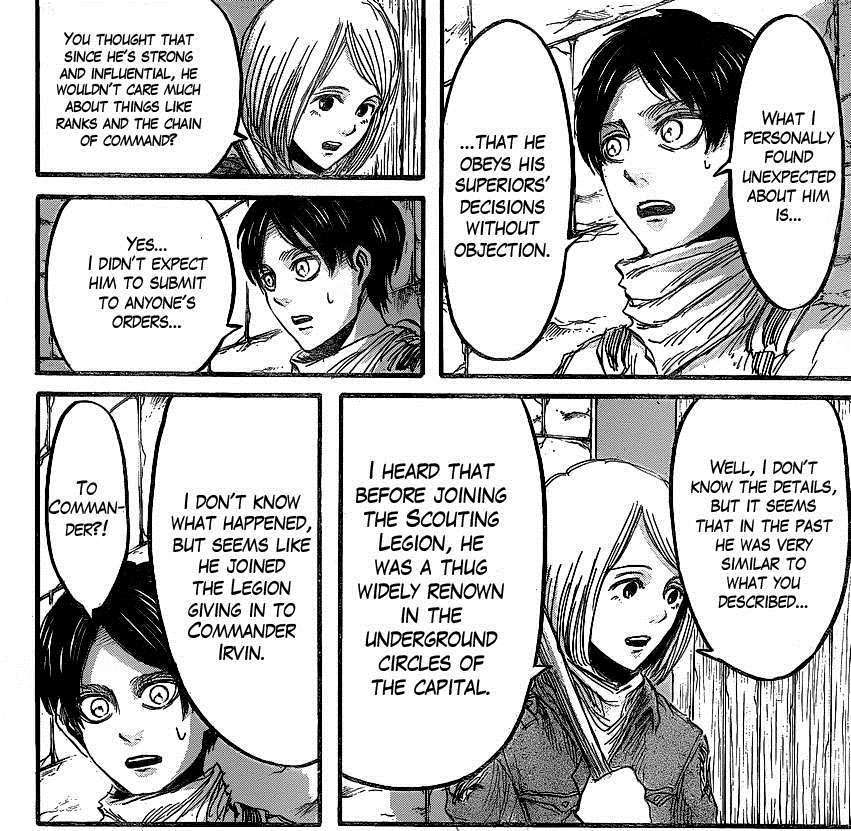
This page is like crazy important okay everyone; I’m going to reference it until you’re sick.
It’s likely the reason why Levi, despite his problems with authority (more on this later), displays such a deferent attitude towards Erwin. Note that I said deferent rather than submissive. It particularly shows throughout the female titan arc.
It’s established only a handful of senior scouting officers were aware of the excursion’s true purpose, and the information was revealed at Erwin’s discretion. When Levi’s squad begins to question and want to deviate from Erwin’s plans, Levi consciously makes the judgement to scold them back into compliance. He consciously made the choice to trust Erwin’s decision to not tell his squad members the operation’s true objective, despite being aware the female titan was intelligent and highly dangerous.
His implicit trust in Erwin is displayed again, when the scouts make a retreat and the female titan is being devoured. Erwin orders him to refill his gas tanks, and while Levi protests, he complies in the end, stating he would “trust Irvin’s judgment”. Even when uncertain of Erwin’s overarching objectives, Levi always defers to his judgment. This attitude is made very clear when his squadron is discussing the future scouting excursion post-Trost and Levi’s response is to deflect strategic responsibility onto Erwin, whom he describes as always thinking “a few more steps ahead”.

I swear I’m not just a silly ship crazy fangirl okay. Shit’s legit.
Unfortunately, we all know how well that ends. I think to some degree, Levi regrets his choice to trust Erwin and not tell his squad of the operation objectives. As noted by Jean after the fact, many scouts “have died when they could’ve lived” due to the lack of information. His demeanor when sitting with Eren after the mission suggests he partially blames Erwin, as he unflatteringly suggests that Erwin was late because he was having trouble “taking a shit”.
It’s a far cry from the intimacy he displayed when he called Erwin by his name before obediently running off to refill his gas. While crass and generally disrespectful, we don’t really see him direct his ire towards Erwin, emphasizing the amount of emotional stress he must’ve been under. It is a testament to the strength of their relationship however, that Levi still complies with Erwin’s command even after.
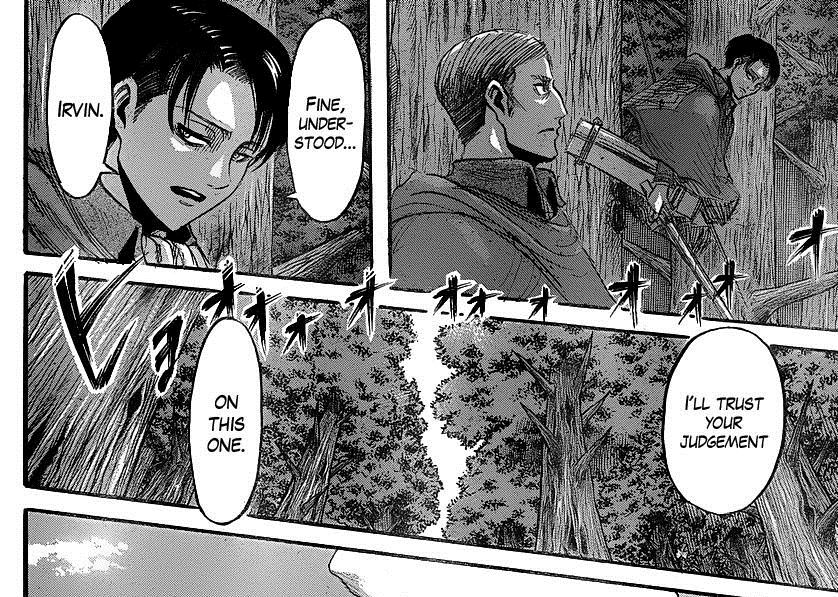
This is probably the most emotionally intimate scene Levi’s been in. Emotional intimacy of course, doesn’t necessitate romance! Considering how harsh Levi usually is, it’s honestly a very sweet moment.
However, Levi’s men still followed Erwin’s directive under Levi’s encouragement, making Levi partially responsible for their deaths. Throughout the story arc, emphasis was made on the fact no one could have predicted its results. Levi mentions it first when he advises Eren that “No one will be able to tell you if it’s right or wrong till you arrive to some sort of outcome.” Armin later makes the comment “You have to make a choice, even though you have no idea what the result might be.” Erwin himself comments that they must adapt to the unexpected, as the female titan displays both intelligence and unheard of abilities, such as summoning other titans.

I do believe that whenever Levi waxes philosophic, such as here, he does genuinely mean what he says. He has a blunt, abrasive personality that doesn’t leave much room for dishonesty or wasted words, so I think this is something Levi believes in and is possibly a conclusion he came to from his own life experience.
Levi brought it up first and he’s the last one to say it, and again, he tells Eren that “no one could have predicted those results”. The repetition serves a narrative purpose to emphasize the fruitlessness of the Scouting Legion’s sacrifice, and how very often, despite their best intentions and hopes, they very often gain little for their suffering. It forwards Shingeki’s deconstruction of heroic sacrifice in shonen manga, but I think it also serves a characterization purpose for Levi.
The second time he says it, it’s established that Levi is emotionally shaken and reeling from the loss of his entire squad. While he was superficially saying that for Eren’s sake, I think the repetition was as much for his own. He was actively reassuring himself of his own decisions, and it’s that mentality, understanding that sometimes death can’t be helped and sometimes people die for no reason, that gives Levi the strength to forgive Erwin as well as himself.

Emotionally gut me like a fish why don’t you.
Not only that, adding in the context of his tendency to deflect responsibility, leads to some rather disturbing conclusions about Levi himself. As I’ve noted before, Levi acts like an audience stand-in and makes commentary consistent with reader first impressions, many of which are quickly unraveling as the plot unfolds. Most examples of competent leadership on his part are tactical decisions rather than strategic ones. In other words, Levi is good at winning battles but bad at winning the war. It characterizes him as someone who is short-sighted, and coupled with his deflection of responsibility onto Erwin who decidedly is not, it creates an interesting dynamic between the two.

See what I mean about deflecting responsibility? 
I think this is the first time we see him really assert his authority and his own command, rather than enforce Erwin’s, and it’s a tactical (short term) decision rather than a strategic one.
While it may not seem disturbing, I think it suggests that Levi is unwilling to trust himself and actively chooses to trust Erwin with his future instead. He trusts himself to Erwin, someone who is described as “able to abandon his humanity to outdo monsters” and jokingly given a 10/10 stat in ruthlessness. It gives their relationship a rather unhealthy cast, though others may interpret it differently.
Levi and Mikasa
I drew a connection between Levi and Mikasa earlier, but I think interesting comparisons between Levi and Mikasa extend beyond strictly combat. Besides what they are and what can do, there is also who they are and what choices they’ve made, in particular, their choice to join the scouting legion. They were both motivated not by personal vision or drive, but other people into the scouting legion, where they truly built their reputations.
Mikasa joins the Scouts because of Eren, while Levi, according to Petra, was brought into the corps by Erwin. By comparing these two relationships, Mikasa with Eren and Levi with Erwin, I think we can gain some interesting insight into both characters and their future development.
Mikasa outright states that her only wish was to be by Eren’s side. Given their history, it’s an understandable sentiment. Eren’s conviction brought Mikasa into the Scouts, and it’s implied that Erwin provided similar incentive for Levi. Unfortunately for Mikasa, Eren is far more hot-headed than Erwin, which leads to probably every problem in Mikasa’s life. Point is, where they are in their lives and where they’re going with them is driven by other people. This is where we can discern some revealing differences that likely stem from the gap in age and experience between the two.

Oh, Mikasa baby, let me give you a hug. Poor thing.
I would argue that Mikasa’s greatest flaw is her tunnel vision when it comes to Eren. She prioritizes him over even her own safety (she attempts to fight Annie alone despite knowing Annie slaughtered entire squads of elite Scouts) and is incapable of functioning without him (her suicidal actions while Eren was “dead” during Trost). It debilitates her agency and clouds her judgment. It doesn’t cause for problems for anyone other than herself until the female titan, when Levi is injured rescuing her from her own recklessness. And again, Levi is acting in a meta way and directly commenting on Mikasa’s flaws through both his words and his actions.

Girl we need to talk about this kill anything that hurts Eren complex of yours.
It’s an important moment for her development, as he confronts her directly about it, and she reassures him she won’t make the same mistake. His comment that he “doesn’t understand her attachment to Eren” shows the fundamental difference in these two relationships. According to Petra, Levi was a notorious street criminal before he was brought into the military, meaning he already had a strongly established identity and sense of self even prior to Erwin whereas Eren was the impetus behind Mikasa’s defining realization the world was cruel. Levi is less defined by Erwin that Mikasa is by Eren, and it gives him the ability to act with more clarity, which we see in the female titan arc when he tells her to trust his judgment to not pursue.
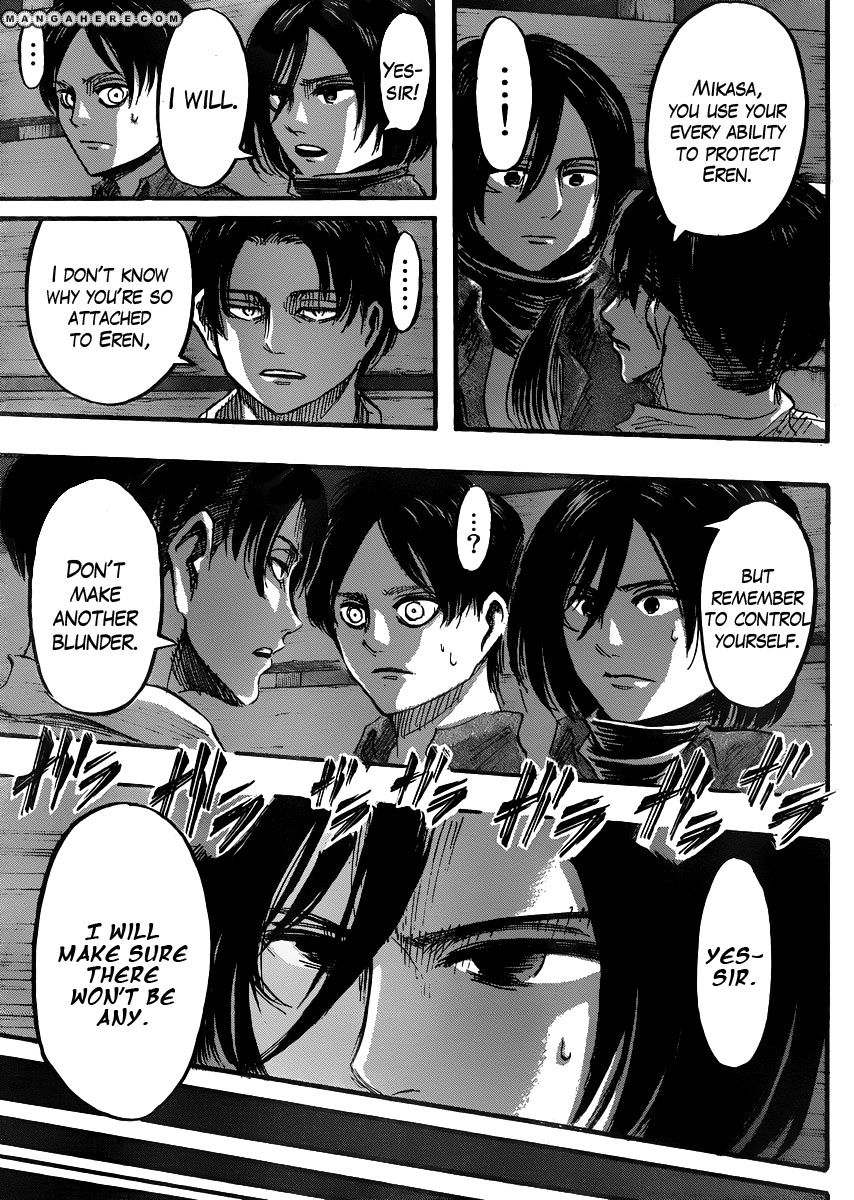
Just this entire page, ugh. Mikasa’s growing up. Or is she truly?
Another gap that influences this is age and general experience. I think the gap in combat experience is pretty self-explanatory and shows when Levi tells Mikasa to trust his tactical judgment. Mikasa is described as having “once in a lifetime talent”, and as a dynamic character (something Levi is not), I don’t think it’s presumptuous to think that Mikasa will surpass Levi in combat skill at some point in the manga. I think the gap is a result of her relative lack of experience, which will be remedied eventually.
A second consequence of Mikasa’s lack of experience and youth is her relative lack of formative experience independent of Eren, a point I established before. However, as she is only 15, she’s still at a stage where she’s learning to define her own identity. We’ll have to see how she develops in the upcoming story arc now that Eren’s been kidnapped, but I think her similarities to Levi point towards her developing a more independent sense of self.
However, if Mikasa is going to become more like Levi, what does it say about Levi? Taking a step back, let’s consider what exactly Levi brings to the overarching story of Shingeki compared to Mikasa. Mikasa is a dynamic character, written to grow and change as the story progresses. Levi is a plot device; he acts as a symbol of hope because of his strength and narratively acts as a control method for Eren. His status as a morale booster for humanity within the bleak and hopeless world of Shingeki works against the likelihood of his survival. I am completely certain that he is going to die, or at least be permanently crippled, to motivate humanity to fight back.
Assuming he dies, which he will, there still remains the question of when. I think the multitude of parallels between him and Mikasa are completely intentional. One such parallel I failed to mention earlier is their mutual lack of charisma. Mikasa attempts to rally the other cadets and fails to do so until Jean intervenes. Similarly, Levi has an abrasive and unapproachable demeanor which is noted by Petra as uncharacteristic of his reputation. He could easily take advantage of it and charm the upper class into funding the Scouts, but doesn’t capitalize on it, likely because it doesn’t suit who he is. I cite his comment that the crowds were being “noisy” as support.
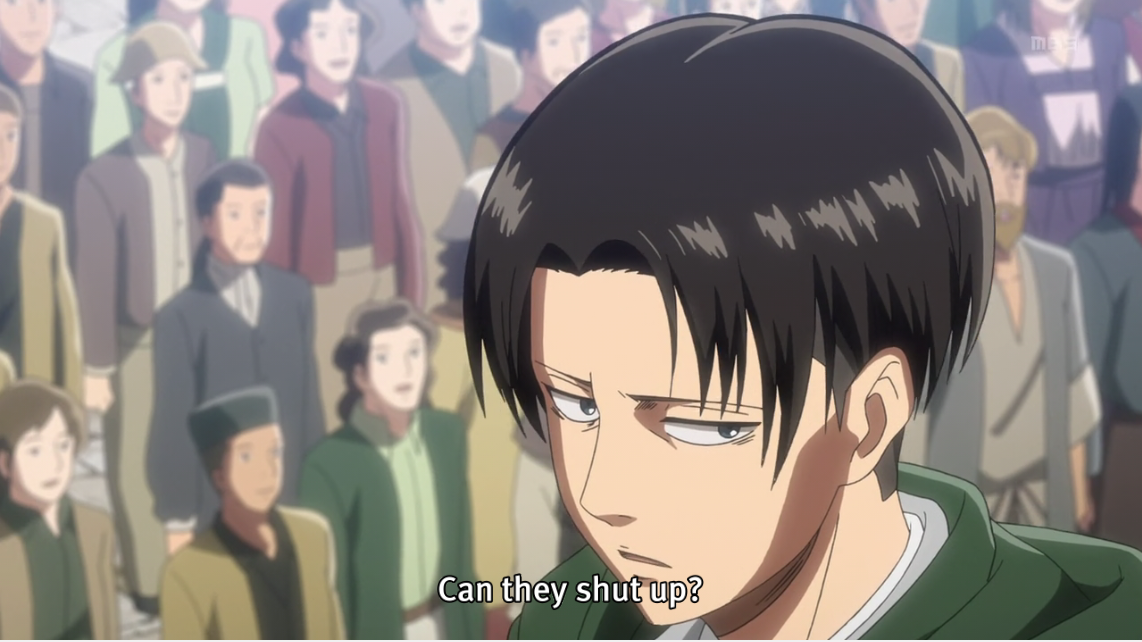
I honestly think Levi’s somewhat misanthropic, based on how he acts all the time.
These many similarities are an indication to me that Mikasa will grow to encompass Levi’s contribution to Shingeki’s storylines. As she gains experience, she’ll likely unseat him from his status as “Humanity’s Strongest Soldier”, and as she grows more independent of Eren, she’ll be able to objectively act as a control for Eren’s titan rampages. In fact, her emotional connection and relationship with him may even work in her favor as demonstrated by Armin’s ability to talk Eren out of a stupor during Trost.
Once this is the case, Levi is an entirely superfluous character. He contributes nothing to the plot, making this a perfect opportunity to kill him. The act would have symbolic value, as he represents hope, and I think it has already been foreshadowed. Levi takes an injury that removes one of his primary storyline contributions, his combat ability, because of Mikasa, and it has been used as a motivator for Mikasa’s development towards greater independence. It wouldn’t be much of a stretch to take him out of the action with something more severe, like death, to further Mikasa’s growth even more.
Levi on His Own
As I mentioned before, Levi displays problems with authority. We see this during the trial, when he scathingly asks if anyone else can handle the responsibility of taking care of Eren. He calls them swine, accuses them of fattening themselves at the expense of the commoners. He’s very, very vicious. He’s smug, he’s confident, he knows who he is, what he can do and what limits he can push. He knows he’s too valuable an asset to be easily gotten rid of, so he knows he’s untouchable. It isn’t limited to the trial even, as later we see him openly ridicule the military police for complaining there were no titans to fight, knowing they joined the police force to avoid fighting titans in the first place.
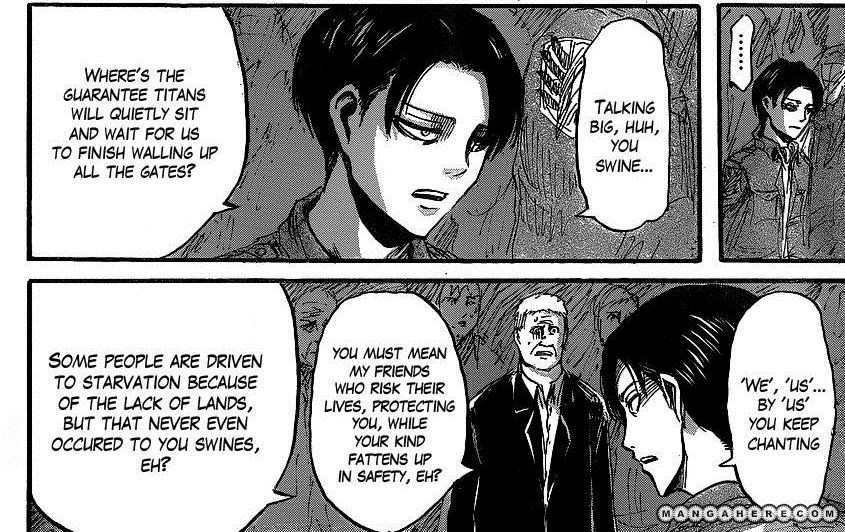
Someone’s bitter.
Joining the Scouting Legion requires a fundamental dissatisfaction with the status quo, but the degree to which Levi openly mocks it suggests far stronger feelings. He isn’t dissatisfied with it; he hates it. He’s angry with it, only he’s emotionally rather stoic and it doesn’t show in his facial expressions, but it shows in every word he says.

Need some ice for that burn?
It makes his criminal background make a lot of sense. As a criminal, he’d be pit against the government and its authority every day of his life. He’d have grown up in a harsh and painful environment, and assuming this is true, it gives an extra layer of depth to everything he said at the trial. His accusations that the religion and the government fail represent or sympathize with commoner interests take on extra meaning because he has directly seen their failures. He has likely seen, living in the underground, people starve to death from lack of resources because of their policies. When he says pain is the most effective teacher, it now develops an undertone of sincerity and personal experience.
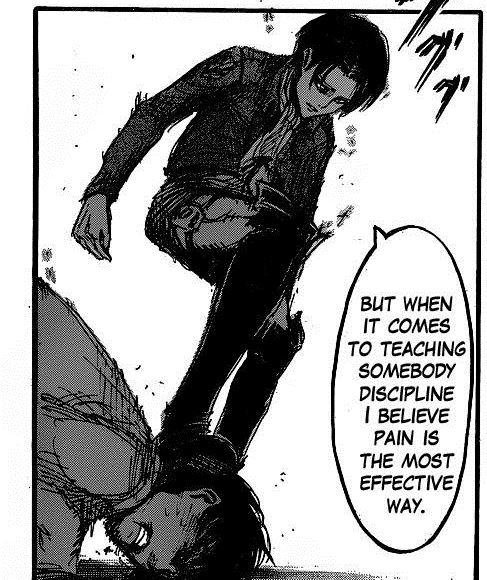
And the panel that launched a thousand fanarts.
Growing up in a harsh and cruel environment would’ve forced him to develop a stoic and abrasive demeanor. Most of Levi’s strong displays of emotion are either scathingly sarcastic or angry, neither of which could be construed as “weakness”. His expression changes are all very subtle, and it’s reasonable to assume they may have developed as a defense mechanism because it’s obvious Levi feels very strongly and is a very emotional person. By this point in his development though, it’s likely too late for him to change.
Furthermore, a criminal background, especially a violent one as street thug would suggest, helps to explain his gleefully violent and sadistic tendencies. It shows when Levi beats Eren at the trial, but I think a better example is when Levi is taunting a restrained Annie. The level of vitriol he directs towards her is high, especially when he comments that “you’ve killed a lot of my subordinates in various ways, haven’t you”. I think his dialogue here is meant to recall his words at the trial, when he accuses the inner city of profiting from the sacrifice of his own comrades. It drives the point home that he absolutely loathes her and it highlights how deeply he does care for his men, if the incident with his dying subordinate didn’t make it clear earlier. He may be stoic, but he is capable of incredible depth of feeling.
More disturbing are what he says to her later, which helps to demonstrate his violent disposition and sadism. He describes taunting her, casually threatening to cut off her hands and feet, not her titan body, but her actual human body as fun for him. Annie has been responsible for some of the most gruesome and violent deaths in the series so far, something Levi has to be painfully aware of because the people she killed were his subordinates, yet Levi tells her that she’s “just like him” that she of all people “would understand” him. If that’s not terrifying, I don’t know what is. He’s reveling in her emotional distress and physical pain.

This is your friendly reminder that Levi is one scary mother fucker please don’t hit him with the moe bat if you want to keep him in-character, okay?
It also shows his short-sightedness, as the most immediate trigger for Annie to summon other titans to devour her was Levi threatening her human body.
Levi and Eren
I think I’ve done a pretty good job of establishing Levi as a very angry person, but do you know who else is angry all the time in Shingeki? Eren! I think the amount of anger and general rage they have is comparable, though the way they express it and where they direct it says a lot about who they are and how their experiences have shaped them.
Eren’s anger against the titan stems from the survivors guilt he feels for being unable to save his mother. It’s compounded once he joins the military and watches his classmate die and made even worse once Levi’s squad gets slaughtered in the process of protecting him. It’s a lot of weight to bear for a 15 year old kid, and he lashes out irrationally and dramatically. His enemy is source of trauma has always been the titans, so he directs all his energy towards them.
Compare Levi, who grew up on the streets. As part of the older generation which grew up during the peaceful hundred years, he has never been as personally affected by the titans during his youth as Eren has. Instead, as a criminal, he butts heads against, not the titans, but the government, nobility and military police. They are his enemy, and they are kept in place by a status quo sustained through the continuous threat of the titans.
I don’t think Levi, given his uneducated background and short-sighted/reckless actions, would have been capable of understanding this. This is one of the reasons I believe Erwin is so absolutely important to who he is, because Erwin is the one who is taking him and redirecting all his talent, strength and fury towards a productive cause, hopeless as the fight may seem. I think Levi is self-aware enough to know these are his flaws, which is why he so consciously defers to Erwin’s commands. Levi fights titans only because they sustain what he truly hates.
In conclusion, Levi is angry, emotionally volatile and reckless. He’s simply so emotionally jaded from his life as a criminal and over five years in the Scouting Legion that he’s developed a veneer of stoicism. While he is capable of great kindness and cares deeply about his men, on the flip side, he is violent, sadistic and equally capable of great cruelty. This sort of emotional oscillation with such extremes, I think, plays into how Isayama portrays the dehumanization of the enemy as a psychological coping method and the deconstruction of black and white morality.