
Chapter Text
Magic curled through shadows, heartbreak lingering for the teenagers at Hogwarts. A tyrannical pink toad had seized the hallowed halls, imposing impossible rules. Some felt the war’s approach, but most students grumbled only about the loss of broom-closet kisses and mixed-gender seating. They cared about the inconvenience and freedoms lost—freedoms unnamed until taken. Few paid attention to the darkness outside Hogwarts’ relative safety.
But this is not their story. It belongs to a girl who felt the war long before it arrived, who carried its weight on her very soul and was haunted by the fear that she’d lose those who meant the world to her in the conflicts ahead. The constant anxiety coiled in her chest, making each day heavy with dread.
The girl’s name was Hermione Granger. Her story began in the harsh light of a dungeon classroom, with a single crimson flower and an ache for something that would last. Here, in this unlikely space, her story truly began.
The dungeon reeked of sulphur and decay. Something rotted beneath the stone, festering for years. The smell coated Hermione’s throat, thick and cloying, making each breath feel contaminated. Cold seeped through her robes into her bones. The damp felt purposeful, as if the dungeon was trying to leech warmth from her body.
She pressed numb fingers against her battered desk and felt the scarred wood beneath her palms. Decades of knife-work, acid burns, and crude phrases lined the surface. Her right hand bore an ink stain she couldn’t scrub away. She rubbed it absently, her pulse climbing before Snape even began.
Her pewter cauldron sat before her, its rim crusted with last week’s failed potion. The residue had hardened into something that looked disturbingly organic.
Snape stood at the front of the classroom like a predator assessing prey—silent, watchful, waiting for the first misstep. The dungeon’s dim light carved shadows across his face, making his expression unreadable and somehow worse for it.
Fifth-year Potions was always something to endure. Under Umbridge, every lesson felt like a tightrope walk. Snape’s mouth was pressed into a thin, bloodless line. Two rows over, Pansy Parkinson’s eyes were bright, hungry to report any infraction.
Hermione’s stomach twisted with anxiety. She forced herself to breathe slowly and evenly, though her lungs felt too tight and her nerves raced.
“Today,” Snape said, his voice cutting through the room like a blade, “we will examine botanical specimens as they relate to advanced antidotes.” He paused, his gaze sweeping across the students with cold precision. “For those of you capable of more than rote memorisation—and I use the term loosely—we will also discuss the theoretical applications of protective magic in potion-making.”
His tone made it clear he expected most of them to fail.
Hermione’s quill scratched across parchment, her handwriting smaller and tighter than usual:
Botanical specimens. Advanced antidotes. Protective magic.
Her pulse thudded in her ears. She tucked the phrases into her mental framework. Still, her hands shook slightly. She pressed them flat against the desk, trying to steady them.
Snape moved to a table lined with terracotta pots and glass jars. The plants looked wrong—too vivid, too alive for the dungeon. Hermione recognised some: purple monkshood, belladonna’s waxy leaves, and deadly hemlock. Others were unfamiliar, their thorny stems and oily leaves gleaming in the candlelight.
The smell intensified as Snape lifted the first specimen—something acrid and bitter that made her eyes water.
“Poison,” Snape said, holding a sprig of monkshood between two fingers like it was something precious, “is merely a matter of dosage and intent.” He slowly turned the plant, letting the light catch its purple blooms. “What kills in large quantities may cure in small ones. What protects may also destroy, given the proper—or improper—application.”
He set the monkshood down with deliberate care and moved to the next plant. Its dark green leaves were unremarkable, but Hermione’s breath caught anyway.
“Belladonna,” Snape continued, his voice dropping lower, more intimate. “Deadly nightshade. Beautiful. Toxic. Entirely capable of stopping your heart if you’re foolish enough to mistake it for something benign.”
The words felt aimed at her. Hermione’s quill moved, but her handwriting grew messy, letters uneven. Her chest tightened. She knew Belladonna—Moste Potente Potions detailed its dangers. Hearing Snape’s words made her skin prickle. Each fact landed like a threat, as if warning her specifically.
Her fingers cramped around her quill. She forced herself to keep writing. The anxiety grew, hot and sharp beneath her ribs.
“And here,” Snape said, his tone shifting into something almost reverent, “we have something rather more… interesting.”
He lifted a plant from the end of the table, holding it high so the entire class could see.
Hermione’s quill stopped mid-word.
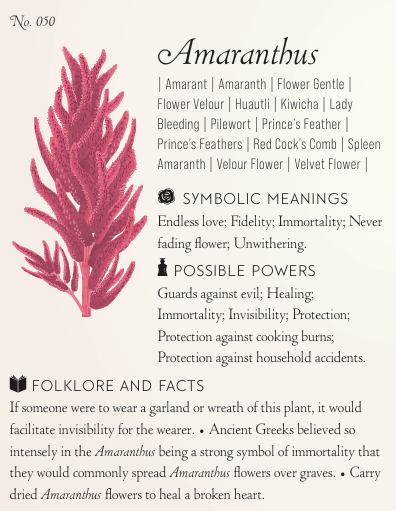
The plant was taller than the others. Its stem was thick, bearing a single upright spray of clustered blooms. The deep crimson flowers seemed to pulse in the dim light, alive and beating. Even from across the room, Hermione saw the velvety petals. They refused to wilt, despite the dungeon’s cold.
They looked like they were thriving.
“Amaranthus,” Snape said, and the word hung in the air like a curse. “From the Greek Amarantos. Unfading. Immortal.”
Hermione’s breath stopped, freezing her in place with a mix of astonishment and a surge of longing.
Immortal.
The word clawed at her chest, dragging up fear she tried to bury. It was not the cold immortality Voldemort craved. This felt human—desperate. The need to protect. The promise that love could last, even as the world broke apart.
Her throat tightened. Her pulse pounded—too fast, too loud.
Snape set the plant on his desk with a gentleness that felt wrong coming from him. The candlelight caught the blooms, making them glow like embers—like something burning that refused to go out.
“Remarkably resilient,” Snape continued, his voice soft and dangerous. “Needs little water. Thrives in poor soil. Bloom’s long after everything else has withered and died.”
His gaze swept across the room, and for a moment—just a moment—his eyes locked on Hermione’s.
She felt pinned to her seat, exposed and vulnerable to the raw intensity of Snape’s gaze, her insecurities threatening to surface.
“In the Language of Flowers,” Snape said, his mouth curving into something that wasn’t quite a smile, “Amaranthus represents endless love. Fidelity. Immortality—though not the kind dark wizards pursue.” He paused, letting the words settle. “Something quieter. The chance at a full life. Not cut short.”
Hermione’s hand jerked unexpectedly, her quill scratching a jagged line across the parchment, as her emotions made her lose focus.
Endless love. Fidelity.
The words lodged in her chest—sharp, insistent. She wanted to look away from the crimson blooms, but she couldn’t. Their beauty and meaning held her gaze with an emotional intensity that made her feel both awed and afraid.
“The magical properties,” Snape continued, his tone shifting back into lecture mode but retaining that edge of warning, “are notable. Amaranthus has appeared in protective charms for centuries, particularly as a shield against curses. A properly enchanted sprig can mean the difference between a fatal wound and a survivable one.”
He scanned the room. Most students weren’t paying attention—Crabbe was half-asleep, Lavender was twirling her hair—but Hermione was frozen, her entire focus locked on the crimson flowers.
Her heart thudded against her ribs. Nothing else mattered. Just the vivid red, the promise of protection, and the desperate longing for safety and enduring love that made her chest ache with hope and fear.
"The plant is rare," Snape added, voice lower. "It grows wild in a few places: parts of the Forbidden Forest, remote parts of Greece and Egypt, and some magical gardens. It cannot be cultivated easily. Its protection requires significant magical effort. That, Miss Granger, is why you won’t find Amaranthus protections in standard textbooks. The knowledge is lost—or deliberately hidden."
Hermione’s cheeks flushed hot with embarrassment and anxiety. Her pulse was racing now, her breath coming too fast, and every muscle in her body felt tense with strain. She wanted to look away, to hide, but she couldn’t.
“Why?” The word escaped before she could stop it, her voice too loud in the quiet dungeon. “If it’s so effective, why isn’t it more widely used?”
Snape’s mouth curved into something predatory. Not quite a smile. Something worse.
“Because, Miss Granger,” he said softly, dangerously, “true protection requires more than ingredients and incantations. It requires intent. Commitment. The kind of magic that can’t be faked or forced.” He turned back to the plant, his fingers brushing the edge of a crimson bloom with a reverence that made Hermione’s skin crawl. “Amaranthus answers to love. The deep, enduring kind. Willing sacrifice. Without that, it’s just a pretty flower.”
The words landed like a blow.
Hermione’s breath hitched. Her hands were trembling now, her quill forgotten. The dungeon felt colder, the smell of decay sharper. Snape’s gaze was still on the Amaranthus, but she could feel his awareness of her—the way he’d aimed every word like a weapon.
He knew. Somehow, he knew she was fixating. He knew she was desperate for this.
And he’d given it to her anyway.
The rest of the lesson blurred into static. Snape’s voice became background noise, meaningless syllables that couldn’t penetrate the roaring in her ears. Her focus stayed locked on the crimson blooms, her mind spiralling.
Endless love.
She thought of the war creeping closer, the one everyone was pretending wasn’t happening. She thought of Harry throwing himself into danger with that reckless, fearless light in his eyes. Ron followed him without hesitation, his loyalty as fierce and breakable as glass. Her parents, distant and fragile in the Muggle world, were vulnerable because of who she was. The Weasleys, warm and welcoming and so terrifyingly mortal.
Fred.
The thought struck like lightning, unwanted and undeniable.
Fred, who made her laugh when breathing felt impossible. Fred, who slipped her Skiving Snackboxes and made her pulse jump with hope and guilt in equal measure. Fred, who was leaving in less than two months, and she didn’t know how to survive that.
Her throat tightened. Her chest ached.
The Amaranthus blooms pulsed in the candlelight, vivid and alive and impossibly beautiful.
She wanted them—the promise of something that would not fade.
She wanted it so desperately that it felt like drowning.
When the lesson finally ended, Hermione stayed in her seat, unable to move. The other students filed out, their voices fading into the corridor. Snape remained at the front of the room, tidying his desk with slow, deliberate movements.
He didn’t look at her. But she knew he was aware of her presence.
The Amaranthus sat on his desk, crimson and unfading, and Hermione couldn’t look away.
Her hands were still trembling. Her pulse was still too fast.
She felt raw, exposed—as though Snape had pulled something out of her she hadn’t meant to reveal.
And the worst part—the part that made her stomach twist with something close to shame—was that she was grateful.
Because now she knew. Now she had a name for the ache in her chest, the desperate need for something that would last.
Amaranthus.
Endless love. Fidelity. Protection.
She would find it. She had to.
Even if it destroyed her.
The Forbidden Forest was alive with a fresh, untamed scent as late afternoon sunlight filtered through golden-green leaves. Delicate spider webs sparkled high above in the branches. Hermione moved softly, her steps muffled by the mossy ground, while her heartbeat echoed in her ears. She wound her way between the trees, heading toward her meeting spot with Fred.
She was early, unbearably early. She was always early for Fred, as if arriving sooner gave her more moments with him. It felt like she could cheat time if she needed it enough.
Their meeting place was a small clearing, fifteen minutes into the forest. It was far from the castle, safe from prefects or Umbridge’s Inquisitorial Squad, but not too deep for dangerous creatures. Fred found it in his third year, while testing a Portable Swamp prototype with George. The trees formed a rough circle with thick, old trunks. In the centre, a fallen log, worn smooth, made the perfect seat.
Hermione perched on the edge of the log now. Her hands were folded in her lap as her school bag sat at her feet, one of its straps stained faintly with ink from a forgotten quill.
She’d changed out of her robes after History of Magic, her final class of the day. Her uniform was too conspicuous and easy to track. Instead of her Gryffindor robes, she wore Muggle clothes; not only were these more practical for navigating the forest, but they were also far more comfortable for a witch raised in the nonmagical world.
Hermione had hastily dressed in her favourite pair of jeans that were starting to fray at the hems, a lilac jumper her mother had knitted two Christmases ago (a stray thread catching on her fingers whenever she was nervous), and a pair of worn trainers that had seen better days with smudges of mud that made them appear off-white rather than their original white.
Her hair was pulled back in a loose plait. Curls were already escaping around her face, and she absently tucked one behind her ear. Her fingers wouldn’t stop moving. She found herself plucking at the loose thread on her jumper, smoothing her plait, re-tucking that same escaped curl that refused to remain behind her left ear. Every passing second stretched unbearably, and she wondered if Fred would come—whether she should run before everything changed. Hope and fear twisted together in her chest, impossible to separate.
She’d been meeting Fred like this for months now. Shared secret meetings that had started as study sessions with her helping him with Transfiguration, while he taught her the finer points of experimental magic not found in any textbook. It had slowly, inevitably, become something else. Their time together made her forget, in his presence, why she’d ever thought order and control mattered.
Fred had become the brightest part of her days. With him, she laughed more easily—forgot, for a while, how much there was to fear. She’d slowly grown to love their meetings, eagerly looking forward to meeting him at their spot in the Forbidden Forest. But all this was about to change soon, because Fred was leaving.
In less than two months, he and George would walk out of Hogwarts in the middle of the school year, abandoning their final exams and Umbridge’s tyranny. They’d leave everything familiar to follow their dreams, to build their shop, Weasleys’ Wizard Wheezes, in Diagon Alley. It was brilliant, brave, utterly Fred in every way. Hermione was proud of him—but it also meant their time was running out, that every meeting in the forest was one step closer to goodbye. She didn’t want to say goodbye to him, for the friendship they’d developed to end.
Her head jerked up at the sound of movement in the trees—a familiar rhythm of footsteps that made her heart leap before she’d even consciously registered it was him. Then he was there, stepping into the clearing with that easy, loose-limbed grace he had, his robes discarded somewhere and his shirt sleeves rolled up to his elbows. His hair was windswept, bright as copper in the slanted light, and a stray leaf was caught just above his right ear. He was grinning at her like she was the best thing he’d seen all day.
“Granger,” he greeted, his voice kind and teasing. “You’re early.”
“You’re late,” she countered, though she was already standing, already moving toward him without quite meaning to.
“Traffic in the corridors,” Fred said solemnly. “Filch was on a rampage about someone setting off Dungbombs near the library. Can’t imagine who’d do such a thing.”
“Fred—”
“Wasn’t me,” he said, holding up his hands in mock innocence. “George, maybe. Possibly Lee. Not me.”
Hermione tried to look stern, but her mouth was already curving into a smile. When Fred closed the distance between them and pulled her into his arms, she went willingly, her hands coming up to rest against his chest. She could feel his heartbeat beneath her palms—alive, real, his—and she pressed closer, anchoring herself to it like it was the only thing keeping her tethered to hope.
“Missed you,” he uttered into her hair. The teasing edge was gone from his voice now, replaced by something softer, something that made her chest ache.
“It’s been four hours,” Hermione commented, but her voice came out quieter than she’d intended, almost breathless.
“Four hours too long.” Fred pulled back just enough to look at her, his hands settling on her waist, his thumbs tracing small circles against her jumper. “You looked distracted in the Great Hall at lunch. What’s going on in that brilliant brain of yours?”
Hermione hesitated. She’d been thinking about the Amaranthus all day, her thoughts drifting to the plant throughout Arithmancy, History of Magic, and a particularly tedious DA meeting where Harry had tried to teach them the Patronus Charm and half the group had ended up in fits of giggles instead. The flower had lodged itself in her mind like a splinter, beautiful and sharp. She couldn’t stop turning Snape’s words repeatedly in her mind: Amaranthus responds to love, the deep, enduring kind—the kind that demands sacrifice.
“Potions,” she replied after a moment of quiet contemplation. “Snape was teaching us about plants. Poisonous ones, mostly, but there was this one—” She broke off, suddenly self-conscious. “It’s probably nothing. Just something I want to research.”
Fred’s expression changed, something knowing playing across his face. “Amaranthus?”
Hermione blinked. “How did you—”
“You’ve been muttering about it under your breath every time I’ve seen you today,” Fred admitted, grinning again. “During dinner, you nearly stabbed Ron with your fork because you were too busy scribbling notes on a napkin. I’m observant, Granger. It’s one of my many talents.”
Her cheeks flushed. “I wasn’t. I didn’t stab him—”
“Nearly stabbed him,” Fred corrected. “There’s a difference. Ron’s still got all his fingers, so I’d call it a win.” He tilted his head, studying her with that intensity he sometimes got, the one that made her feel like he could see straight through her walls. “So, Amaranthus. Why is the great Hermione Granger fixated on such a bloom?” he asked her, focusing on her face, his hazel eyes interested, waiting for her response.
Hermione bit her lip. “Snape said it’s rare. That it has protective properties, but only if—” She stopped, the words catching in her throat. Only if there’s love. Deep, enduring love. the kind that demands sacrifice.
Fred’s hands tightened slightly on her waist. “Only if what?”
“Nothing,” Hermione responded quickly. “It’s just. It’s interesting, that’s all. The magical theory behind it. I might look for it in the forest, see if I could find a specimen to study.”
For a moment, Fred didn’t say anything. Then he reached into his pocket and pulled out a small sprig of flowers. The blooms were a deep, velvety shade of purple and black, while their leaves were dark and waxy. He held it out to her. Hermione’s breath caught.
“Is that—”
“Belladonna,” Fred said, his voice suddenly serious. “Deadly nightshade. Beautiful, isn’t it? Also, extremely poisonous. If you’d gone wandering around the forest looking for Amaranthus without knowing what you were doing, you might’ve picked this instead. And then I’d have to spend the evening force-feeding you antidotes instead of doing much more enjoyable things.”
Hermione stared at the flowers, her heart beating fast. They did look beautiful—dark, delicate, almost hypnotic. She could see how easy it would be to mistake them for something harmless, something worth picking.
“How did you know I was going to look for it?” she asked quietly.
Fred’s mouth quirked. “Because I know you, Hermione. You don’t just research things; you hunt them down, you take them apart, you figure out how they work. And because—” He hesitated, then tucked the belladonna back into his pocket and reached for her hand instead, his fingers lacing through hers. “Because I’ve been watching you. The way you look when focused on something you find interesting. I see that intensity now, the way you’ve been looking at flowers differently ever since your potions lesson this morning. You’re obsessed.”
“I’m not obsessed,” Hermione protested, but it sounded weak even to her own ears.
“You are,” Fred insisted. “It’s one of the things I love about you. When you care about something, you care completely. No half-measures.”
The word love hung in the air between them. Hermione felt her pulse spike. They’d been careful not to say it. Not yet, not when everything felt so uncertain. But it was there anyway, in the way Fred looked at her, in the way her chest ached when she thought about him leaving.
“I do know about Amaranthus,” Fred confessed, brushing a calloused thumb tenderly over her knuckles. “Mum taught me some of that flower’s stuff, back before we trampled her garden as kids. Roses are love. Forget-me-nots for remembering, I think. Amaranthus—she always said it just doesn’t give up; it keeps thriving against all odds. It has its own kind of magic.”
Hermione’s throat contracted. “Snape said the same. He claimed it was strong for protection. He said it didn’t offer the immortality desired by dark wizards. It was about living a full life. A natural life. Protected from dying too soon, but the magic was rare and connected to intent.”
“Yeah,” Fred nodded, his tone softer now. “It’s about getting a fair go, isn’t it? Not forever. Just… the time you’re meant to have. Together.”
The forest went quiet in that way it sometimes did, like it was listening and didn’t like what it heard. Hermione could hear the faraway call of a bird, the murmur of leaves in the breeze, and the faint trickle of water from a stream somewhere deeper in the trees. The light of day was fading now, the gold turning amber. Fred’s face was half in shadow, his eyes radiant and steady on hers.
“You’re leaving,” Hermione whispered. The words came out raw, unguarded. “In less than two months, you’re leaving. I don’t. I don’t know how to—”
“I know,” Fred exhaled. He pulled her nearer, his free hand coming up to cup her cheek. “I know, Hermione. But leaving Hogwarts doesn’t mean leaving you. It just means we’ll have to—” His voice wavered. “We’ll have to work harder. Write more letters. Steal more weekends. I’ll come back every chance I get. You’ll come to the shop when you can. We’ll make it work because—” His voice cracked. “Because I can’t—
I’m not giving this up. I’m not giving you up.”
Hermione’s eyes stung. “What if it’s not enough? What if the distance is too much, or the war gets worse, or—”
“Then we’ll—” Fred stopped, his breath hitching. “Then we’ll deal with it. Together. That’s what Amaranthus means, isn’t it? Endless love. Fidelity. The promise that we’ll—that we’ll fight for this, for each other, no matter what.” He leaned in, his forehead resting against hers, his breath warm against her lips but unsteady. “I’m not going anywhere, Granger. Not really. You’re stuck with me.”
A laugh escaped Hermione’s throat, half-sob, half-relief. “That’s a terrible line.”
“It’s a great line,” Fred countered, but his voice shook. “You’re just too smart to fall for it.”
“I already fell for it,” Hermione whispered. Then, quieter, like she was admitting something dangerous: “I fell for you.”
Fred’s eyes darkened. Then he kissed her—tentative at first, like he wasn’t sure he should, like he was waiting for her to pull away. Their lips met for the first time. It was her first kiss. His hands slid into her hair carefully, hesitantly, and Hermione felt herself melting into him even as part of her brain whispered what if this is a mistake? What if you’re not ready, what if—
She kissed him back anyway, her fingers clutching onto his shirt, her heart thudding maddeningly fast. The kiss was slow, overwhelmed with everything they couldn’t say. When they broke apart, breathless, Fred rested his forehead against hers, and she could feel him trembling.
“I’ll find you real Amaranthus,” he promised, but his voice was unsteady. “Not belladonna, nothing dangerous. The real thing. Whatever comes, I’ll—I’ll be there.”
Hermione’s breath hitched. “Fred—”
He squeezed her hand too tightly. “I mean it. I love you, Hermione. Over the past few months, I’ve fallen head over heels for you. If you’ll have me—I’m yours. I know it’s fast, mad, reckless, but I want you. All of you,” he confessed, and something desperate threaded through it.
The words landed like something real. She was crying. She was smiling too. “I love you,” she whispered. Then, because she couldn’t seem to stop herself, “I want to try. I really do.”
Fred kissed her again, softer, a promise against her lips that felt fragile. “We’ll try. We’ll make this work,” he vowed, but it sounded like he was trying to convince both of them.
They stayed like that as the light faded, the forest growing darker around them. Hermione pressed closer to him, her fingers tightening in his shirt, anchoring herself to his solid warmth and to the reality of Fred being hers. She clung to the promise, desperately trying to believe that maybe, just maybe, they’d make it through together.
When they finally pulled apart, Fred reached into his pocket again and pulled out a different flower. Not belladonna this time, but something small and white, with delicate petals and a sweet, faint scent.
“Jasmine,” he declared, tucking the flower behind her ear with shaking fingers. “For love and attachment. A placeholder until I find you the Amaranthus.”
Hermione touched the flower gently, her fingers brushing the soft petals. “You really do know the Language of Flowers,” she commented, surprised.
“Told you,” Fred replied, his grin returning. “I’m full of revelations.”
“You are,” Hermione agreed. She kissed him again, slow and sweet, pouring everything she couldn’t say into the press of her lips against his.
When they finally left the clearing, hand in hand, the forest was dark, and the castle lights were glowing in the distance. Hermione’s heart felt too full—too fragile to trust it. Fred would leave. The war would come. But for now, they were together, clinging to each other and the promise neither of them was entirely sure they could keep.